
SKED 3D
3D Printing in a nutshell
3D printing is an additive manufacturing method. This manufacturing technique
dates back to the time of the pyramids, where an object is joined to another to
create a new object. In this example, several carved stones are joined to create
an impressive structure! There are several methods for 3D printing, each
serving different needs. In this guide, we will focus on filament 3D printing and
resin 3D printing.
Filament 3D printing is the most well-known method; you probably know someone who even owns a filament 3D printer. Filament 3D printing is done by heating plastic. When the plastic is soft and malleable, the machine deposits the filament to create an object. The movements are controlled by the printer’s internal computer. This method is fast and provides results of medium to good quality. The layer height is typically 0.2mm, but it can be adjusted from 0.12mm to 0.6mm. The layers formed by the printer are visible to the naked eye. Once the print job is complete, you simply need to wait for the piece to cool down before removing it from the machine. Filament 3D printing requires little to no post-processing after printing.
Resin 3D printing is a more complex process that requires more safety precautions. To start, liquid resin is placed in a vat with a transparent bottom. When the printing begins, UV light is projected through the bottom of the vat. This light allows the resin to polymerize. Then, the print bed moves up and down to allow resin to flow under the part. This process is repeated until the final product is completely printed. Once the part is printed, it needs to be cleaned and cured to stabilize the resin on the surface. During handling, it is recommended to use nitrile gloves, as the resin can burn the skin. Resin 3D printing allows a precision of 0.05mm, with layers that are almost imperceptible to the human eye.
Filament 3D printing is the most well-known method; you probably know someone who even owns a filament 3D printer. Filament 3D printing is done by heating plastic. When the plastic is soft and malleable, the machine deposits the filament to create an object. The movements are controlled by the printer’s internal computer. This method is fast and provides results of medium to good quality. The layer height is typically 0.2mm, but it can be adjusted from 0.12mm to 0.6mm. The layers formed by the printer are visible to the naked eye. Once the print job is complete, you simply need to wait for the piece to cool down before removing it from the machine. Filament 3D printing requires little to no post-processing after printing.
Resin 3D printing is a more complex process that requires more safety precautions. To start, liquid resin is placed in a vat with a transparent bottom. When the printing begins, UV light is projected through the bottom of the vat. This light allows the resin to polymerize. Then, the print bed moves up and down to allow resin to flow under the part. This process is repeated until the final product is completely printed. Once the part is printed, it needs to be cleaned and cured to stabilize the resin on the surface. During handling, it is recommended to use nitrile gloves, as the resin can burn the skin. Resin 3D printing allows a precision of 0.05mm, with layers that are almost imperceptible to the human eye.
Material Selection
Material selection is a crucial choice in 3D printing. Indeed, this choice has a
significant impact on the final part or product. The table below provides
guidance for selecting the best material, depending on the application for your
part.
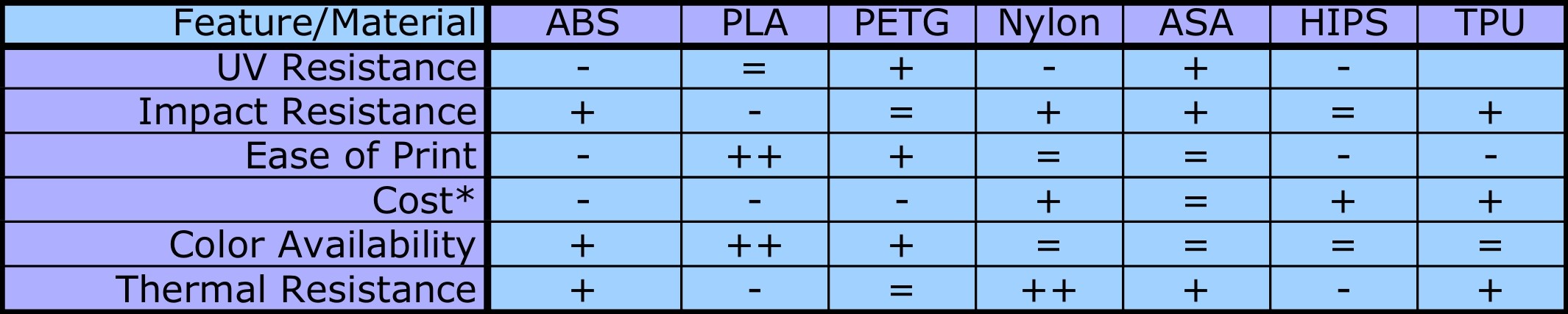
A low cost is indicated by the negative symbol under the material. More
properties can be studied before selecting a material.
Feel free to contact the SKED team for any questions related to your material
selection!
3D Printing Process Selection
When selecting the process, several parameters must be considered. Here is a
list of questions to help you guide your selection.
If you want to obtain your piece quickly, with correct details and good integrity, we suggest filament printing.
If you want a high-precision product or one with a lot of details, we suggest resin printing.
Every project is unique and has different needs and constraints. The choice of technology is debatable, and our team would be happy to assist you in ensuring the success of your project. If you have any questions, feel free to contact us via email! email!
- What is the function of my object?
- What is the appropriate material for my application?
- What is the desired surface finish of my product?
- What is my budget?
If you want to obtain your piece quickly, with correct details and good integrity, we suggest filament printing.
If you want a high-precision product or one with a lot of details, we suggest resin printing.
Every project is unique and has different needs and constraints. The choice of technology is debatable, and our team would be happy to assist you in ensuring the success of your project. If you have any questions, feel free to contact us via email! email!